

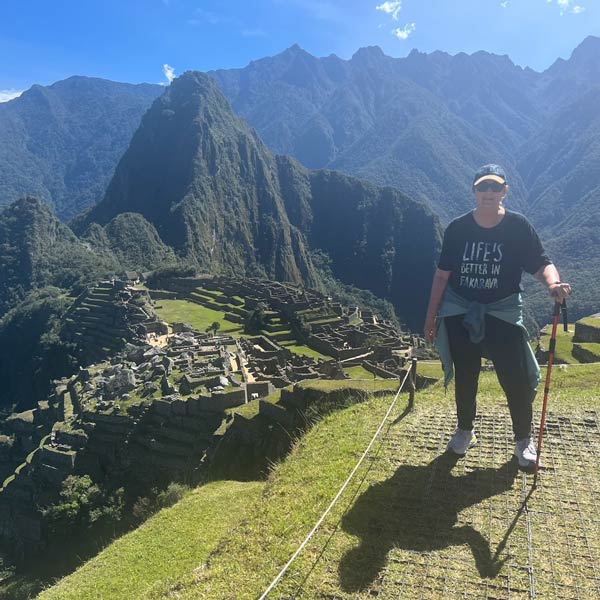
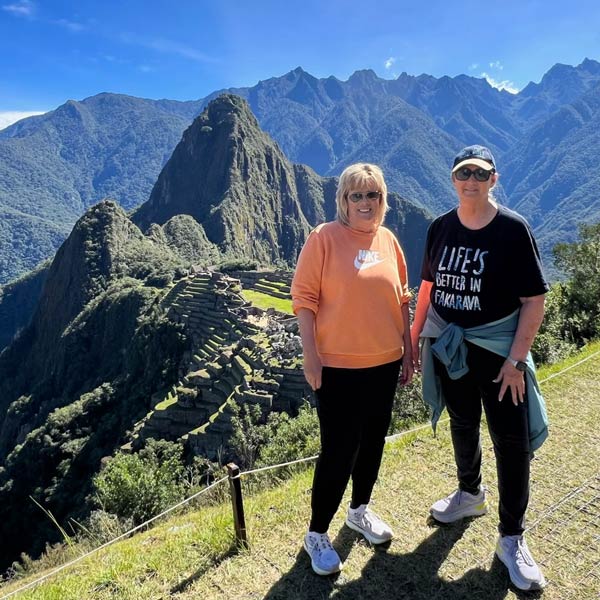
Words can’t describe the feeling of euphoria one feels as you step thru the ancient walls on top of Machu Picchu and see this amazing immense city spread out on the top of the mountain. This is my second visit, and I can assure you, pictures do NOT capture its mystical and astounding beauty. There’s no question as to why It’s been credited with being the 7th Wonder of the Modern World. The mere fact that 600 years ago a small group of people could build a city of rock with such precision, complexity and perfection is truly inconceivable to my tiny brain. After a brief stop to regain our composure, we stepped into this ancient wonderland.
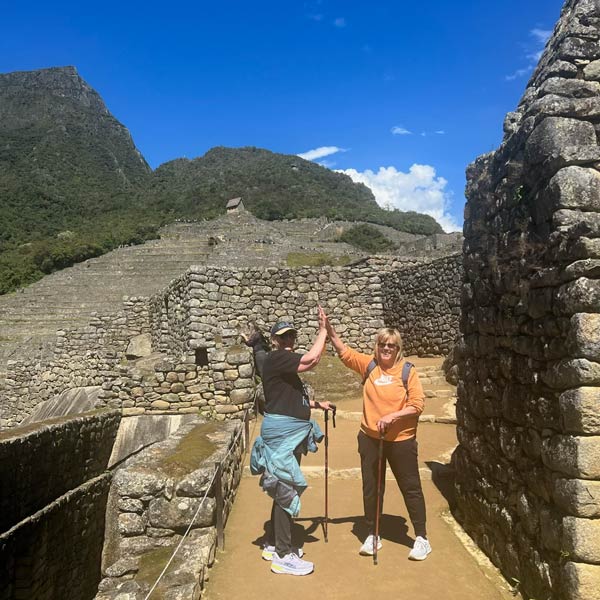
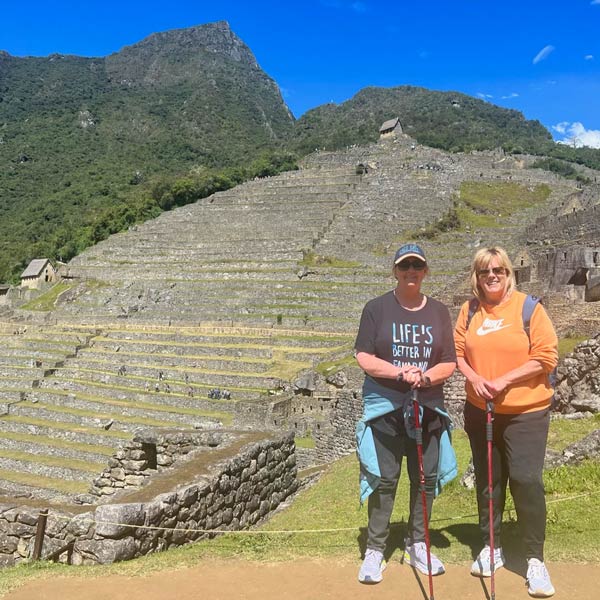
We spent the next 3 hours exploring,
the well preserved ruins… and absorbing all the interesting data our guide was throwing at us.
Machu Picchu is built 7700 feet above sea level in the middle of a tropical mountain forest. All the structures are made of cut stones fitted together without mortar so tightly that its cracks still can’t be penetrated by a knife blade.
One of the most important questions that immediately comes to mind as you’re gazing across the mountaintop…Why did the Incas decide to build their city near the top of THIS particular mountain? NO….not necessarily for protection like you read about when you study castles in Europe. They considered three much more practical survival reasons…
Water, Rocks, and their Calendar. The mountain provided the rainfall for the crops; there was a rock quarry near the top of the mountain to build their houses; and, there were mountains to the east and west that had a V shape at their summits that provided them the time of year to plant their crops. When the sun was in the center of the east V shape, they planted; and, when it was in the west V shape, they harvested. The maximum population was limited to 1,000 because of the water supply.
Remember when the Spaniards came in the 1600s and destroyed most of the Inca cities and their monuments… well this city was kept a secret for many, many years until an American, Hiram Bingham convinced a small local boy in 1911 to show him the ruins, which by then were covered in jungle. Many credit Hiram with the discovery of Machu Picchu but actually he was only the “announcer” to the world because the local Chesqua people knew about it for 300 years prior.
Hiram did establish the basic info on the site with photos and documentation, but the crime was he took the artifacts back to the US and to this day very few have been returned to the people of Peru . The site was opened to the public in the early 1950s and then Deemed a World Heritage Site in 1983.
As you walk thru the ruins, you see Llamas grazing on the terraces. They keep the grass cut and don’t pull it up by the roots like Alpacha would. You also notice the detailed difference in the housing construction between royalty and the common people, especially in the level of perfection of the cut stones. In fact, there’s only one bathroom in the entire city…you guessed it… in the King’ digs. It’s simply a hole no larger than 3″ in diameter cut into the stone floor with drainage down the mountain. There are several awesome chapels and a tomb in the complex. I can’t even begin to describe the intriguing architecture or explain how advanced their planning was for being back in the 13th century.
On this site there’s several huge Angel trumpet bushes. This flower is poisonous and extremely intoxicating. Robbers use it on tourists to get them to turn over their money without a fight. It was also one of the natural drugs. , the Incas used to put the women and children to sleep before they sacrificed them. They also have cocoa plants which are used to make tea and other products and are only legal in Peru and Bolivia….Yep, because they also make cocaine from this plant.
If you want to absorb this fascinating part of our world’s history, VISIT NOW … because currently they have already limited your time to 4 hours and in a couple of years, they will reduce to 2 hours. This is to avoid the deterioration of the site. Currently there are 6,000-10,000 visitors per day. This is a definite bucket list item for anyone who appreciates history.
Worn out from all the steps, we headed back into town and I enjoyed the local pisco sour, while Connie had her usual vodka tonic with lime. Ready to board the train back to Cusco and then head to Lima tomorrow.





0 Comments